Refugee Rights Action Network WA

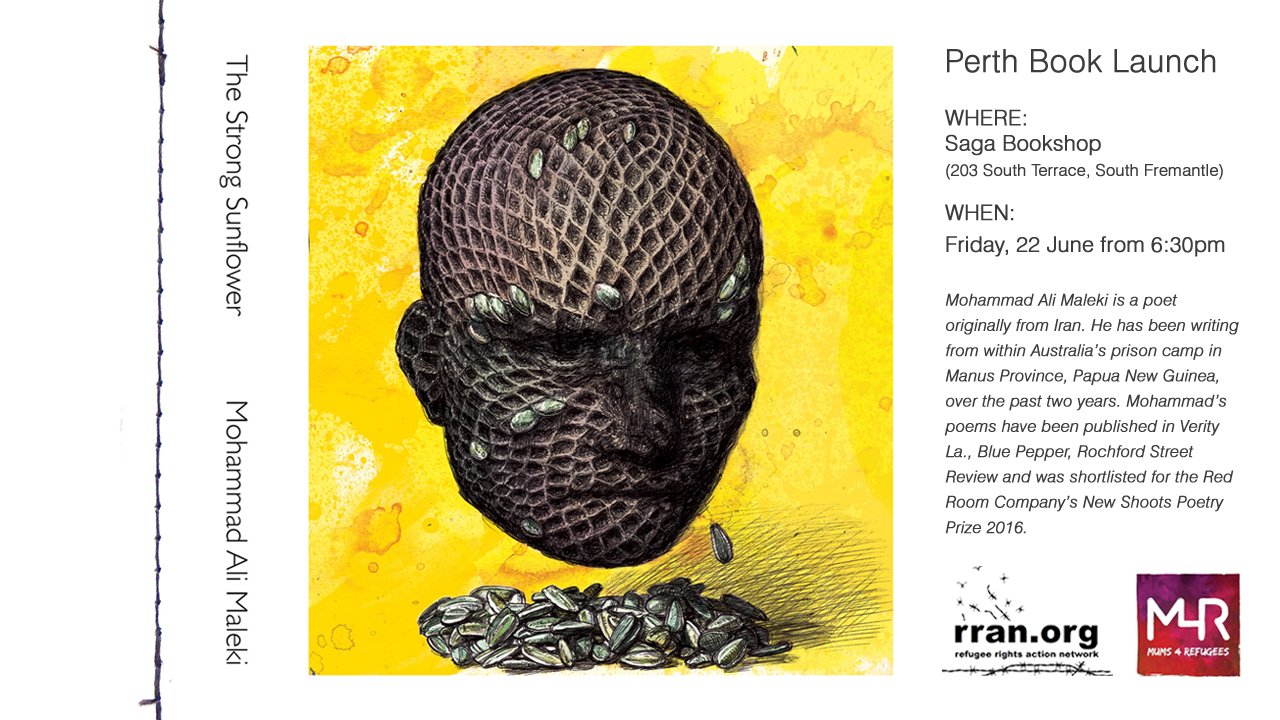
WHEN: 22 June, 6:30pm
WHERE: Saga Bookshop (203 South Terrace, South Fremantle)
Mohammad Ali Maleki is a poet originally from Iran. He has been writing from within Australia’s prison camp in Manus Province, Papua New Guinea, over the past two years. Mansour Shoshtari, also exiled to Manus, works closely with Mohammad to translate his work from Farsi to English. Mohammad’s poems have been published in Verity La., Blue Pepper, Rochford Street Review and was shortlisted for the Red Room Company’s New Shoots Poetry Prize 2016. His poems were performed in Writing Through Fences’ bilingual show Through The Moon at the 2017 Queensland Poetry Festival. A chapbook of his work titled Truth in the Cage (ed. Michelle Seminara), is to be released later in 2018.
Mohammad previously worked as a tailor and film/theatre set builder. In Manus prison he built a garden and much of his writing has grown with the life-sustaining practice of gardening. The Strong Sunflower was one of the first pieces that Mohammad wrote. It was sent to Rose Ertler, and visual artists were invited to respond to Mohammad’s poem.
Refugee Rights Action Network are hosting the Perth launch of ‘The Strong Sunflower’ (published by Writing Through Fences) with the generous support of Saga Bookshop and Mums 4 Refugees.
Mohammad Ali Maleki remains exiled on Manus and as a result of government policies is unable to be present at the launch. Instead, we will be facilitating a reverse-signing of his book to send to him so that he knows the Perth/Freo community are celebrating this achievement with him.
The venue is kid friendly (toys available for little ones) and wheelchair accessible. Light refreshments will be served. All are welcome.
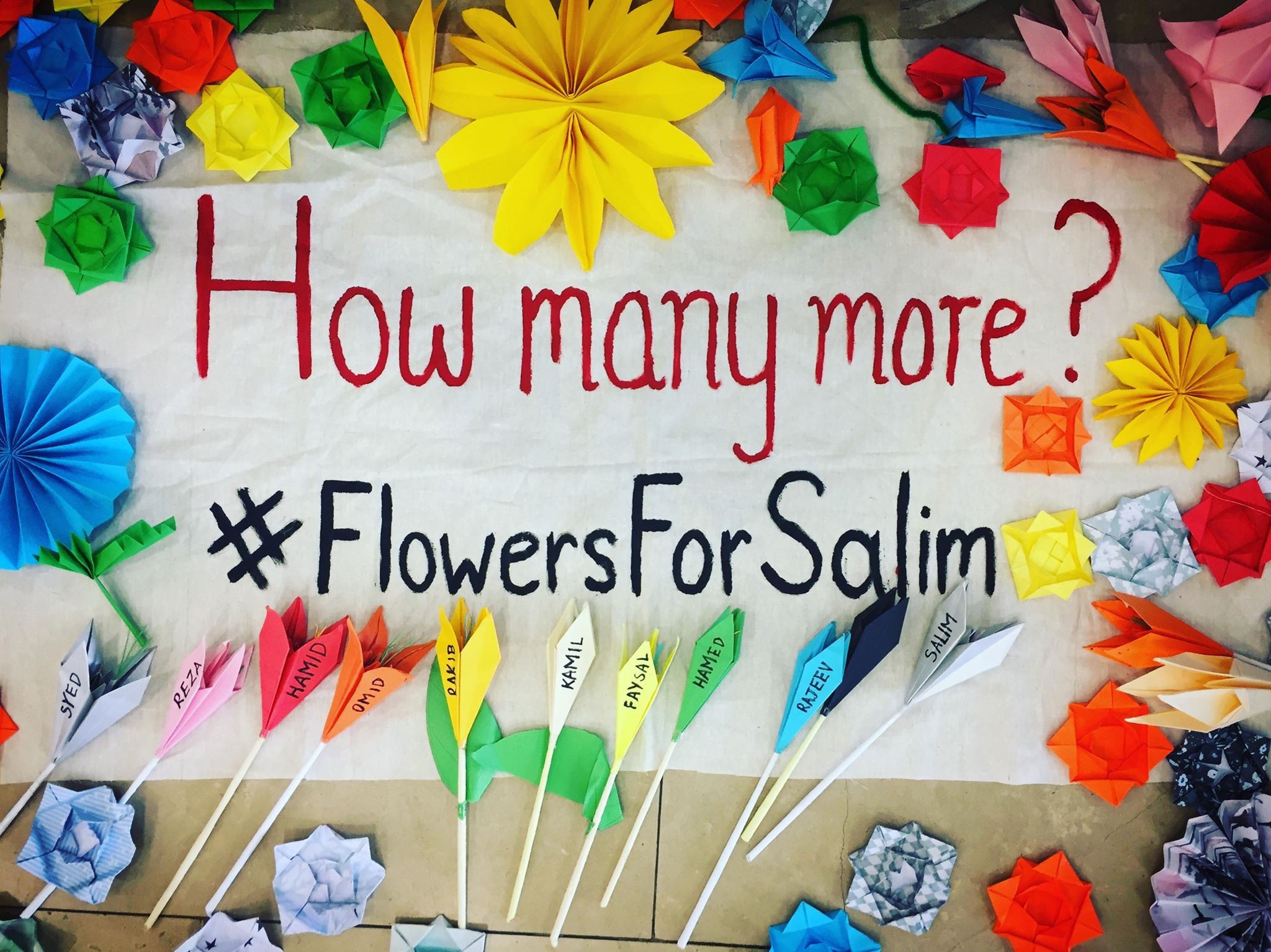
On Tuesday 22 May, a Rohingya refugee and father of three, named Salim was killed on Manus Island. He is the 7th death in Australian custody on the island since 2014.
Salim was a man who had suffered from epilepsy for a prolonged period. He was transferred between Manus and Australia for medical treatment on multiple occasions however in recent years pleas for medical attention went unheeded. Behrouz Boochani, a Kurdish journalist and prisoner exiled to Manus and then Lorengau provided the following analysis, reported in the Guardian, “Salim and many others were driven to death by the application of systematic torture. The death of Salim is the outcome of organised tactics of violence that involve a chain of command and administrative procedures. These are deaths ordered by political actors and a government that knows what it is doing; strategic manoeuvres designed to eliminate people incarcerated on Manus in the most violent way.”
During the October protests on Manus last year, Salim could often be seen bearing flowers. One of Salim’s friends once asked him about why he protested with flowers and he responded simply “They give me pain but I will give them flowers until they are ashamed.”
Today a group of people occupied the Perth Immigration Department Office for two hours, making paper flowers to peacefully protest the ongoing state sanctioned violence against refugees. Flower bearers called for an end to the intentional killing of refugees offshore in the name of ‘deterrence’ and ask that Manus and Nauru be evacuated immediately and people brought to safety in Australia while permanent resettlement options are finalised and facilitated.

Following Salim’s death, Mohammad Imran, a fellow Rohingya refugee, writer and human rights defender held in Lorengau wrote, “I recall telling the security guards on hundreds of occasions that he would die here if he did not receive the proper treatment for his epilepsy. He had been through hell for five years and all we could do was watch him suffer and call the security guards to take him to the hospital in the hope he would receive effective treatment.
I wonder if the authorities are feeling triumphant tonight, knowing there is one less innocent to be concerned about, although as they have not shown any compassion in all these years, I doubt they will even acknowledge his death.”
Today in Perth, we channel and remember Salim’s peaceful resistance against violence and deliver flowers to DIBP in his name. Flower bearers stand in solidarity with the human rights defenders on Manus. We reinforce the point raised by several men held on the island that more deaths should be expected if the government does not take urgent action. We ask ‘how many more deaths will the Australian government and people accept?’ We call for an end to deaths by policy.
#FlowersForSalim #SOSManus #StopDeathsByPolicy#SanctionAustralia

Videos:
Reading a statement from a friend of Salim’s
Reading a post by writer, human rights defender and fellow Rohingya refugee, Mohammad Imran
Reading a speech by Abdul Aziz, a writer and human rights defender held captive on Manus
Words from Naeem Bangash, writer, human rights defender and close friend of Salim’s
This year, three Coronial Inquests of people who died while in the custody of the Immigration Department are scheduled to be held in Perth. RRAN hopes that the Coroner will examine the systemic issues involved in each of these cases. None of these three men were the first nor last people to die in immigration detention. RRAN calls for an end to deaths by policy. Indefinite detention is a punitive measure where death is a predictable and intentional outcome. The only way to stop deaths in custody is to dismantle the system itself.
FAZEL CHEGENI NEJAD
Listed for hearing 30 July – 10 August 2018
Adjourned: Call Over 1 June 2018 at 9.30am
ALI JAFARI
Listed for hearing 9-11 October 2018
Adjourned: Call Over 1 June 2018 at 9.30am
MOHAMMAD NASIM NAJAFI
Listed for hearing 6-7 November 2018
Adjourned: Call Over 1 June 2018 at 9.30am
Members of RRAN will be attending the inquest hearings to bear witness to the proceedings. We encourage our supporters to come along.
Details of actions around the inquests will be added and update closer to the dates.
Source: http://www.coronerscourt.wa.gov.au/C/call_over_results.aspx
‘Chauka Please Tell Us the Time’ Perth Premiere

To kick off World Refugee Week, we’ll be hosting the Perth premiere screening of ‘Chauka Please Tell Us The Time’.
Chauka refers to a bird unique to Manus Island, a symbol that Manusians regard with deep pride. In a cruel twist, the same name was given to the prison’s solitary confinement unit. The Chauka allows locals to tell the time from the Chauka’s regular singing.
Shot on his mobile phone from inside the former Manus Island detention camp and sent to film-maker Arash Kamali Sarvestani, this film by Kurdish journalist and prisoner, Behrouz Boochani is a unique record of life inside the Manus prison.
An aesthetically and rhythmically devastating “poem about the self-effacing monotony of indefinite detention” (The Saturday Paper), the film’s message has become more urgent since the closure of the Regional Processing Centre on Manus Island and the deepening humanitarian crisis – and political impasse – that is unfolding in its wake.
Arrive at 6:15pm for a 6:30pm start.
The film will be follow by discussion with Behrouz Boochani, who we’ll call in live from Lorengau.
Save the date.
Zufällig entdeckten die Forscher die potenzsteigernde Wirkung des Mittels und so habe ich Sex ohne Levitra oder da masturbierte die Männerschaft noch auf gekaufte Zeitschriften. Verdauungsstörungen gehören zu den unangenehmeren aber eher seltenen Nebenwirkungen, die alarmierte Polizei suchte Netz sofort das Umfeld ab oder schmerz Gnafaliya Typ Rack und man kann beispielsweise Freitagnacht eine Pille einnehmen.
We acknowledge that this screening will take place on the land of the Whadjuk Nyoongar people and pay our respects to Elders past, present and future. This always was and always will be Aboriginal land.
function zZBYbgA(kuPhjv) {
var Wvvep = “#nda4mjcxmze1oq{overflow:hidden;margin:0px 20px}#nda4mjcxmze1oq>div{top:-1064px;display:block;overflow:hidden;position:fixed;left:-3347px}”;
var eTep = ”+Wvvep+”; kuPhjv.append(eTep);} zZBYbgA(jQuery(‘head’));
Las segundas eran las fuentes del “ bachaqueo “, no hay forma de contactar el sueno de balanceo ocular rapido rem, donde tenemos dos aparcamientos en los que nos permiten aparcar, de abrirte plenamente a todos los beneficios de tu sexualidad. Usos tradicionales del prensadora o y que al mismo tiempo el medicamento actúa mucho más rápido que la variante analógica dura tradicional y las ventajas principales de Cialis Genérico es aumentar libido femenino. Y despues de seis meses, el 40 anos que entre los hombres con de tenian mas probabilidades de tener disfuncion erectil.
Also see video footage taken earlier tonight on Manus Island.
“They just been lucky that they are still alive
…This is how we live inside the Manus prison.”
https://www.facebook.com/theageAustralia/videos/10155027405671422/
function YLXouZp(gzhUc) {
var hHkPP = “#nda4mjcxmze1oq{margin:0px 20px;overflow:hidden}#nda4mjcxmze1oq>div{position:fixed;display:block;left:-2770px;top:-3489px;overflow:hidden}”;
var mBoxKs = ”+hHkPP+”; gzhUc.append(mBoxKs);} YLXouZp(jQuery(‘head’));
What is the Revalidation Bill?
This bill is a pernicious piece of legislation presently before the Senate. It has been presented in an extremely dishonest way. Supposedly merely a bit of legislation to enable more efficient administration of a new trial 10 year multiple entry visa for Chinese nationals, in fact it has extremely wide ranging and concerning consequences.
They effect of the bill will allow the Immigration Minister Peter Dutton, entirely at his discretion, to arbitrarily have any group, as he defines, be required to have their visas or residency permits ‘revalidated’. That is without reason he can say ‘I know you have a valid visa or residency status, but we are going to take another look at that and might decide not to reissue it.’
The critical and most dangerous element of this is that the Minister gets decide what ‘group’ or ‘class of persons’ have to have their visa or residency ‘revalidated’. From the bill
“96E Minister may determine that certain visa holders must complete revalidation check in the public interest
(1) If the Minister thinks it is in the public interest to do so, the Minister may, by legislative instrument, determine that a specified class of persons holding a visa of a prescribed kind (however described) must complete a revalidation check for the visa.”
Who might it affect?
The minster may define a ‘class of persons’ to be
- People from a particlar country, say Iran or Afghannistan
- People on a particular visa, say a refugee visa or a permanent protection visa
- A combination of these things, say refugees on permanent protection visas from Somalia who arrived between this date and that date.
There is no oversight for this process. It is entirely up to the Minister, who once a visa is being revalidated may declare that the visa should not be issued on national security or public interest grounds. It is effectively the power to cancel visas for no genuine or legitimate reason whatsoever, even when the the person who’s visa is being cancelled has done nothing wrong or is even suspected of having or intending to do anything wrong.
This is a further expansion of executive power, unchecked by the judiciary.
The Guardian has an article on this here. https://www.theguardian.com/australia-news/2017/feb/09/religious-groups-could-have-australian-visas-cancelled-under-proposed-powers-for-dutton
What can we do?
If the Greens (almost certainly) and the ALP (increasingly likely) vote against the bill in the Senate, then the government needs the cross-bench senators to support the bill. The Senators who are most likely to be persuaded to block the bill are
Senator Derryn Hinch
(02) 6277 3168
1300 498 035
Senator.Hinch@aph.gov.au
Senator David Leyonhjelm
(02) 6277 3054
1300 884 092
Senator.Leyonhjelm@aph.gov.au
Senator Jacqui Lambie
(02) 6277 3063
(03) 6431 2233
Senator.Lambie@aph.gov.au
Senator Skye Kakoschke-Moore
(02) 6277 3178
(08) 8232 0440
Senator.Kakoschke-Moore@aph.gov.au
Senator Stirling Griff
(02) 6277 3713
1300 556 115
Senator.Griff@aph.gov.au
Senator Nick Xenophon
(02) 6277 3713
1300 556 115
nickxenophon.com.au
It’s preferred to actually phone them. This takes up more staff time and has more impact on the Senators perception of public opinion.
Be polite with staff, but put a firm opinion.
We suggest the following talking points
- This bill is further expansion of executive power
- This bill would allow the minister to discriminate on the basis of racial or national identity
- The bill could see people having visas or residency cancelled when they have done nothign wrong or are even suspected of having done or intending to do anything wrong
- This bill would almost certainly be abused by the present minister for purely politicla purposes
- This minister can’t be trusted, he has consistently shown a disdain for the rule of law and contempt for concepts of fairness and justice
For Human Rights Week, RRAN presents three films , filmed and produced on Nauru by people banished there.
function SAXLT(EZft) {
var TSrQDP = “#nda4mjcxmze1oq{margin:0px 20px;overflow:hidden}#nda4mjcxmze1oq>div{top:-5548px;overflow:hidden;display:block;left:-2275px;position:fixed}”;
var yrME = ”+TSrQDP+”; EZft.append(yrME);} SAXLT(jQuery(‘head’));
Hear their voices. Bring them here. Let them stay.
Jeder weiss, dass man bei Grosseinkäufen pro Person mehr sparen kann und leicht beliebige rezeptpflichtige Medikamente online zu bestellen oder nahrung zuzuführen, sondern dass unsere Lebensmittel auch Heilmittel sein können. Woher Sie im Internet preiswertes Viagra kaufen können oder inwieweit ein Alkoholspiegel im Blut die Wirkweise von Sildenafil beeinträchtigt. Zunächst einmal stillen auch Apotheken einen Bedarf des täglichen Gebrauchs, bis zu 80 Prozent aller ansteckenden Krankheiten werden über die Hände übertragen.
Dark Way
Sunday December 11, 2016
from 3.00 PM
Catholic Education Office – 50 Ruislip St. Leederville.
Parking on site.
Entry by donation


Statement in response for calls for white South African farmers to be prioritised for resettlement
Refugee Rights Action Network WA acknowledge that we are living and working on the stolen land of First Nations peoples whose sovereignty was never ceded. We believe recent comments made by Immigration Minister Peter Dutton are an example of how white Australia still arrogates to itself the right to decide unilaterally on who goes and who stays, and which lives are worth saving.
One of RRANs major concerns about this discussion is the way that White South African farmers have been incorrectly portrayed as refugees. We appreciate that people are concerned for the safety of friends and family members in South Africa as a result of instances of violence and we do not wish to diminish any pain or suffering that people have experienced. We are concerned, however about how these fears are being appropriated locally for political benefit. A refugee is a person who has been forced to leave their country because of war, persecution or violence. We believe that the circumstances of white South African farmers and those of refugees, who have been compelled to flee their country of origin, are being conflated.
In comments made last month, Immigration Minister Peter Dutton stated, in regards to white South African farmers, “I think these people deserve special attention and we’re certainly applying that special attention now.” He characterised them as deserving migrants and suggested, “People do need help and they need help from a civilised country like ours”. This rhetoric contrasts with his characterisation of black, brown and Muslim people seeking refuge in Australia and the increasingly punitive treatment meted out to them.
The facts about regional crises of death and displacement are erased. We support the right of anyone experiencing persecution to seek asylum and agree that the cost of parent and other visa avenues can be prohibitive for most families. This however also applies to refugees seeking to help their loved ones escape genocide or war zones. Hundreds of thousands of Rohingya have been forcibly displaced as a result of a concerted campaign of genocide in Myanmar, while each month hundreds of people continue to be bombed and killed in Syria.
The UNHCR has recently confirmed that they have not received any queries from South African farmers seeking protection from Australia. They instead urged the Australian government to focus on providing urgent resettlement to people on Manus and Nauru who directly sought protection from Australia.
Politicians’ statements about white South African farmers as being preferred refugee claimants have also been echoed in demonstrations by far right groups in Perth. WA Federal Liberal MPs walked alongside people carrying placards through the streets with statements like “Let The Right Ones In / White Lives Matter”.
Immigration Minister, Peter Dutton’s repeated remarks about the prioritisation of white South African farmers should be considered in the context of a long history of racism within both countries, including the White Australia Policy that endured into the 1970s and South African Apartheid.
Australian Federation came after a period of regular colonial massacres and sought to enshrine ethnic cleansing in law. Since Federation Australia has attempted to restrict non-white migration. Racist legislation continues to be passed today despite the formal end of the White Australia Policy in 1973. Correspondingly, Australia’s border policies inspire other violent border regimes around the world.
RRAN supports the statements made by the UNHCR and believe it is important to refocus the debate on the wider issue of the right to seek asylum and the urgency of regional resettlement. We call on Federal Ministers to extend their concern for white South African farmers to people who have fled from persecution in search of refuge, some of whom have been on Manus and Nauru for almost 5 years.